The Envelope's Handover Test: Air-Barrier Continuity as a Program Gate
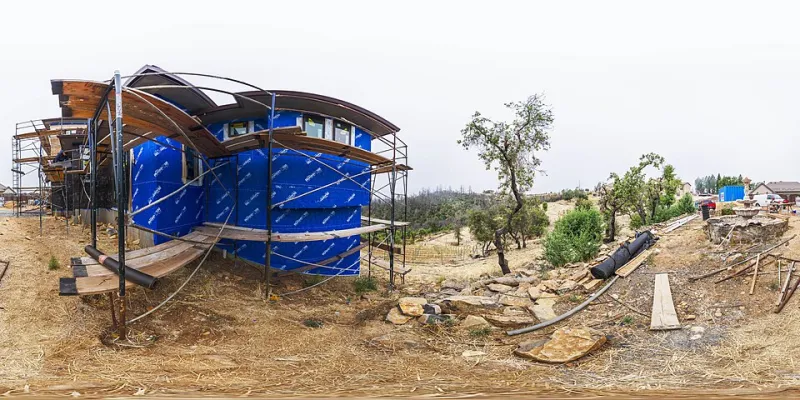
Photo: Bob Dass, CC BY 2.0, via Wikimedia Commons
On many US projects, the air barrier is managed as a subcontractor closeout item: a membrane installed, a blower-door test scheduled, a report filed. That framing is too narrow for the way buildings actually fail. Air-barrier discontinuities emerge at transitions — where a curtain-wall anchor penetrates a weather barrier, where a duct riser interrupts a ceiling membrane, where firestopping meets an exterior sheathing plane. Each is small. Together they create a turnover problem that no single trade owns and no single inspection catches.
The better approach is to treat air-barrier continuity as a program-level gate. That means defining it at bid stage, giving it named hold points in the schedule, and requiring a documentation package that commissioning agents and owners can actually use. In 2026, with US energy codes tightening and building envelopes carrying more performance responsibility, the gate is no longer a quality nicety. It is a delivery control.
Why the Air Barrier Belongs in Program Delivery
An air barrier is not a product. It is a system of substrates, membranes, sealants, transitions, penetrations, and interfaces. Its performance depends on sequence. If mechanical rough-in occurs after the membrane is complete, someone must own the repair protocol. If facade work follows roofing, the transition detail must be inspected before it is buried. If firestopping is installed by a different trade, the air-barrier continuity at that penetration must be verified by someone with authority to reject it.
On a large US project, these interfaces multiply quickly. A single building may have dozens of roof-to-wall transitions, hundreds of mechanical penetrations, and thousands of linear feet of sealant joints. The risk is not that any one detail is difficult. The risk is that responsibility is distributed so widely that continuity becomes no one's explicit deliverable. At turnover, the commissioning agent runs a whole-building test, finds leakage, and the program absorbs rework while the schedule absorbs delay.
A Gate With Named Hold Points
The first step is to stop treating air-barrier inspection as a final test. Build a series of hold points into the schedule, each tied to a trade milestone and each requiring sign-off before work proceeds. A practical set for US projects includes:
- Substrate readiness: verification that sheathing, masonry, or concrete surfaces are acceptable for membrane application, with moisture and temperature conditions recorded.
- Membrane application: inspection of field membrane continuity before any covering work begins, including lap and termination details.
- Penetration and transition sealing: inspection of every planned penetration, including mechanical, electrical, and structural connections, before concealment.
- Pre-closing verification: a walk-through of areas about to be closed by drywall, ceiling, or facade work, with photographic documentation keyed to the continuity plan.
- Final performance test: whole-building or compartmentalized testing under ASTM E779 or the project-specified protocol, with acceptance criteria stated in the contract documents.
Each hold point consumes inspection resources. That is precisely why it belongs in the schedule rather than in a trade's quality program. Hold points are finite. If they are not planned, they become emergency inspections that compete with commissioning and delay turnover.
Trade Sequencing Rules That Protect Continuity
A gate is only as good as the sequence it protects. The contract documents should establish a small number of non-negotiable rules. First, no penetration of a completed air-barrier membrane without a written repair procedure and inspection sign-off. Second, no concealment of a transition detail until the continuity inspector has reviewed it. Third, no trade may rely on another trade's sealant as a primary air-barrier component unless that responsibility is explicitly assigned and accepted.
These rules sound administrative. In practice they change the schedule. Mechanical rough-in must be sequenced before membrane completion in some zones, or after with a repair protocol in others. Facade mock-ups must include air-barrier transitions, not just weather tightness. Roofing and waterproofing trades need a shared detail library for wall-to-roof interfaces. The program delivery team, not the envelope subcontractor alone, should own the sequence map.
A Documentation Standard That Survives Handover
Turnover documentation for air-barrier continuity should be assembled as a single package, not scattered across subcontractor closeout binders. It should include the continuity plan, product data and batch information, installer qualifications, inspection records for each hold point, photographic logs keyed to location, repair records, and final test results. The package should be indexed by building zone and by penetration type so that facility staff can locate a detail years later.
This matters beyond commissioning. US owners are increasingly asking for envelope maintenance plans, and air-barrier continuity is part of that asset record. A well-indexed package supports future penetrations for tenant improvements, equipment replacements, and facade repairs. A thin package does not.
The Cost of Deferring the Gate
When air-barrier continuity is deferred to final testing, the program pays in three places: rework, schedule, and performance risk. Rework is visible. Schedule is measurable. Performance risk is quieter: a building that passes a test on a mild day may still underperform in service, and the owner inherits the gap.
Treating continuity as a gate does not eliminate defects. It makes them visible earlier, when they are cheaper to correct and less likely to collide with commissioning. For US programs in 2026, that is a reasonable trade: a small amount of planned inspection capacity in exchange for a turnover sequence that does not depend on discovering the envelope's weakest point at the end.