Buying Lower-Carbon Concrete Without Stalling the Pour
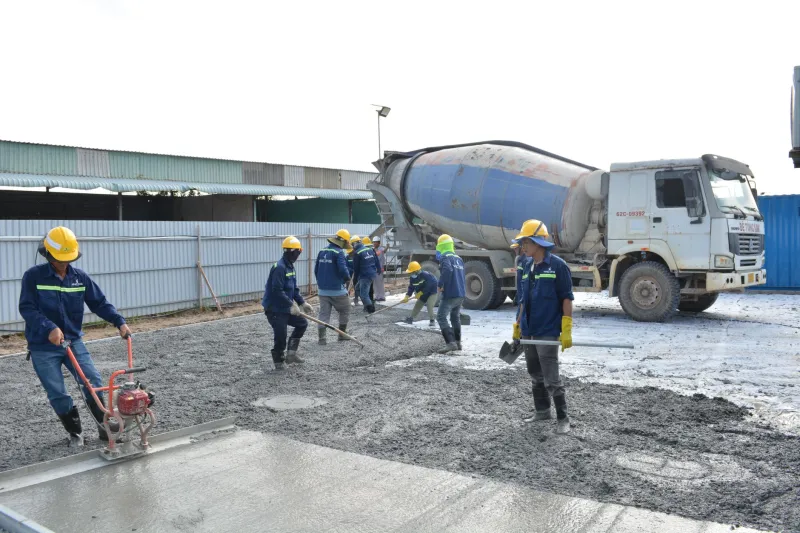
Ask a project engineer on a US highway or transit program what worries them about lower-carbon concrete and the answer is rarely the chemistry. It is the submittal that comes back rejected, the trial batch that has to be re-run, the ready-mix supplier forty miles away who cannot source the supplementary cementitious material the specification assumes, and the pour that slips a week while everyone argues about a test cylinder.
That is the practical shape of the embodied carbon conversation in 2026. Federal and state procurement rules, owner sustainability commitments, and voluntary rating systems have converged on concrete as the single largest addressable line item in a project's carbon profile. Concrete is also the material poured in the largest volumes, on the tightest cycles, by the most locally fragmented supply chain in construction. Those two facts sit in tension.
The resolution is not to slow down the ambition. It is to buy more carefully.
Specify Performance, Not a Recipe
Prescriptive specifications were written for a world in which the goal was consistent cement content and predictable strength gain. When the goal shifts to lowering embodied carbon, prescriptive language becomes actively counterproductive, because it locks out precisely the substitutions — slag, fly ash, limestone-calcined clay, and other supplementary cementitious materials — that do most of the work.
Performance-based specifications set the outcomes: compressive strength at a given age, durability requirements, shrinkage limits, temperature control, finishability, and curing. They leave the mix design to the producer, subject to qualification. This is not a novel idea — ACI 318 and AASHTO provisions have supported it for years — but it is unevenly applied, and the transition is where schedules break.
Two disciplines make the transition survivable. First, if a project intends to allow extended setting time or slower early-age strength gain, that decision must be made in design, not discovered in the field. Second, any performance requirement must be testable with methods the local laboratory can actually run on the schedule the project requires.
Read the EPD, Then Read It Again
Environmental product declarations have become the currency of green procurement, and like any currency they are subject to inflation. A declaration prepared under a recognized product category rule, independently verified, and scoped to the specific plant supplying the project is a genuinely useful document. A declaration covering a regional average, or an industry-wide benchmark, tells you something about the sector and very little about the truck arriving on Tuesday.
Procurement teams should confirm four things before accepting a declaration as evidence: the product category rule version it was prepared under, the verification body, the facility or facilities in scope, and the declared unit. Where an owner's policy requires documentation, that requirement belongs in the bid documents with a sample declaration attached — not in a post-award request that pushes the producer into a scramble and the project into a delay.
It is also worth stating plainly in the contract that a declaration is a disclosure instrument, not a performance guarantee. Treating it as the latter invites disputes that no one wins.
The Batching Plant Is the Real Constraint
A lower-carbon mix that cannot be produced within the project's haul time is not a lower-carbon mix; it is a change order. Before any specification is finalized, someone on the team needs to know which plants can serve the site within the allowable delivery window, what supplementary materials those plants have under contract, and how much silo capacity they have for a second cementitious product.
This is unglamorous diligence and it prevents most of the delays that get blamed on sustainability. In much of the country, slag and quality fly ash availability has tightened considerably as coal generation retires and competition for supplementary materials intensifies. A producer who can theoretically make a 40 percent slag mix may only be able to make it on certain days, at certain volumes, with certain advance notice.
Where local capacity is genuinely limited, a program can still make progress by targeting the highest-volume, lowest-risk elements first — mass concrete, foundations, and non-structural elements — rather than insisting on a single project-wide mix.
Pilot the Mix Before You Commit the Pour
Trial batches are the cheapest insurance available on a concrete program and the most frequently skipped. A meaningful pilot covers more than compressive strength: it examines slump and workability over the haul, setting time under expected ambient conditions, finishability for the specified surface, and the behavior of the mix in the actual formwork and placement method the project will use.
Acceptance testing should then be agreed in advance, with named methods and named sampling frequencies. Where maturity monitoring is used to supplement cylinder breaks, the correlation must be established on the project's own mix rather than borrowed from a prior job. Where the specification permits strength compliance at 56 or 91 days rather than 28, that provision needs to be reflected in the structural schedule — otherwise the project discovers, mid-pour, that it cannot open the next work front.
Put Schedule Protection in the Contract
Finally, the commercial documents should anticipate the obvious frictions. Useful provisions include a defined submittal review clock for mix designs and declarations, an agreed process for approving alternate supplementary materials without a formal change order, a mechanism for pre-qualifying two or three producers rather than one, and explicit allocation of responsibility when a specification-compliant mix is unavailable locally through no fault of the contractor.
None of these clauses is controversial. Together they determine whether a lower-carbon specification is a routine part of project delivery or a recurring source of claims.
The argument for low-carbon concrete is settled in policy terms across most of the US public sector. The argument that remains is a delivery argument, and it will be won in the batching plant, the laboratory, and the submittal log — long before the first truck arrives at the gate.