Mill Certificates and Milestones: Putting Domestic-Content Risk on the Pre-Bid Schedule
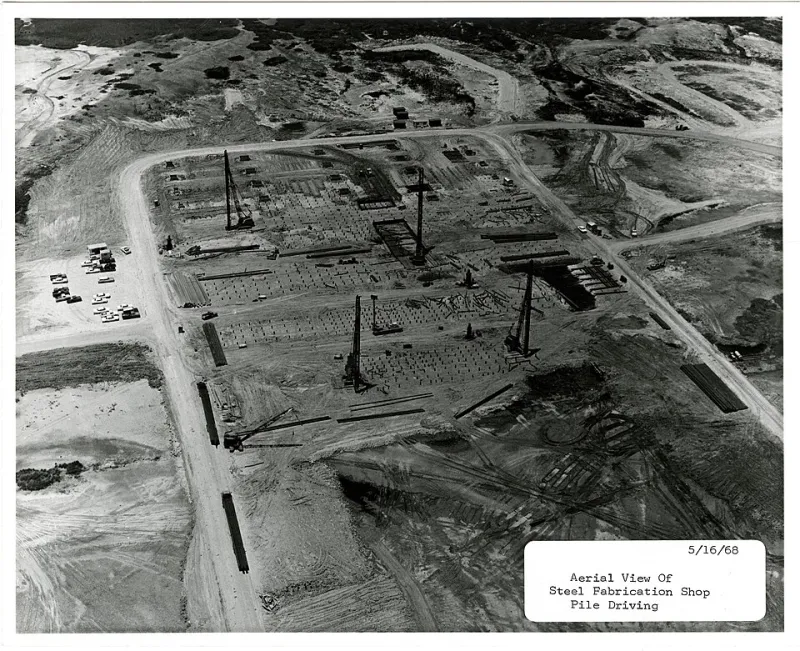
Photo: Mississippi Department of Archives and History, No restrictions, via Wikimedia Commons
For US project teams, the domestic-content rules attached to federal infrastructure funding are often treated as a paperwork exercise to be resolved after award. That assumption is expensive. The requirements reach steel and iron, manufactured products, and construction materials, and they apply at the point of fabrication and assembly, not at the point of delivery. When a fabricated assembly cannot be documented as domestic, the schedule does not merely lose a form; it loses the fabrication slot, the mill roll, and the erection sequence behind it.
Since the 2021 Infrastructure Investment and Jobs Act expanded federal infrastructure spending, domestic-content conditions have moved from a specialty concern to a mainstream procurement task. For industry readers, the useful question is not whether Buy America matters. It is where the requirement sits in the bid calendar, and who owns it before the first price is submitted.
The Rule Is Simple; the Supply Chain Is Not
Buy America and Build America, Buy America requirements are usually summarized in a few sentences: iron and steel must be melted and manufactured in the United States; manufactured products must meet a domestic-content threshold; construction materials must be produced domestically. The compliance question is not only where the steel was melted. It is also who coated it, who cut it, who assembled it, and whether each sub-tier can provide traceable documentation.
For manufactured products, the domestic-content calculation is based on the cost of components, and the threshold is not static. It rises on a published schedule, so a calculation that was correct at the start of a multiyear program may not hold at the end. Electrical equipment, pumps, and controls often carry global sub-components. A bid that assumes catalog availability can discover after award that the selected product does not meet the domestic-content test, and that the compliant substitute has a longer lead time. That is how a compliance clause becomes a schedule clause.
Pre-Bid: Build a Domestic-Content Register
Before pricing, develop a register that maps each specified product to its likely compliance pathway: iron or steel, manufactured product, construction material, or excluded item. Identify the decision-maker for each. Flag items where the domestic-content calculation depends on sub-tier cost data. Assign an owner. The register should live with the estimate, not in a compliance binder that no scheduler opens.
The register should also capture the evidence required. Mill test reports, domestic-content attestations, and sub-tier declarations are not interchangeable. A supplier may be able to document steel origin but not component cost. Another may have a domestic assembly location but imported enclosures. The pre-bid register should record which evidence exists, which is missing, and which supplier is responsible for producing it.
Qualify Suppliers on Paper and on Calendar
Pre-qualification should test two things: whether a supplier can document domestic origin, and whether it can hold a fabrication slot. Ask for mill test reports and domestic-content attestations before bid. Ask for current lead times in writing. A supplier that is compliant but booked 40 weeks out is a schedule risk even if the paperwork is perfect.
For steel, confirm plate availability and coating capacity. For manufactured products, confirm component sourcing and the location of final assembly. For electrical gear, confirm the origin of enclosures, breakers, and controls. These checks are not a substitute for contract compliance, but they tell the estimator where the schedule is exposed. A compliant supplier with no capacity is not a compliant supply chain.
Waivers Are a Sequence, Not a Switch
Waivers for nonavailability, unreasonable cost, and public interest are sometimes treated as a fallback that can be pulled at any time. In practice, a waiver request requires justification, review, and in many cases public posting. The time between identifying a need and receiving a determination can be measured in weeks or months, not days.
Sequence the waiver path before bid. Identify items likely to require a waiver, collect market evidence, and estimate review time. Where a waiver is uncertain, carry the compliant alternative as the base bid and price the waiver as an alternate. This prevents a post-award surprise in which the project is waiting on a determination while the fabrication shop is idle. It also gives the owner a clear comparison between the cost of compliance and the cost of delay.
Buffers That Reflect Real Mill and Fabrication Lead Times
Schedule buffers for domestic-content compliance should not be a single percentage applied to the whole program. Break the buffer into documentation, fabrication, and review. The documentation buffer covers mill certificates, attestations, and sub-tier data. The fabrication buffer covers the difference between catalog lead time and domestic-compliant lead time. The review buffer covers owner and funding-agency checks.
For long-lead items, place compliance milestones on the schedule as activities with predecessors, not as notes in a assumptions log. If a mill certificate is a predecessor to fabrication release, it belongs in the schedule logic. If a waiver determination is a predecessor to procurement, it belongs there too. When these events are visible, the project team can see the critical path forming before it becomes critical.
How to Write It Into the Bid
Bid documents can require a domestic-content plan with the proposal: a register, named suppliers, lead-time letters, and a waiver strategy. Evaluation can include compliance maturity as a qualitative criterion, not merely a pass-fail checkbox. Contract documents can require sub-tier flow-down and monthly compliance reporting. The goal is not to add paperwork. It is to make compliance visible early enough to affect procurement decisions.
Post-Award Discipline
After award, hold a compliance kickoff with procurement, engineering, and the scheduler. Convert the register into a live tracker. Require supplier documentation before fabrication release. Review waivers monthly. Track lead-time drift. When a substitution is proposed, rerun the domestic-content test before approving it. These steps are ordinary program controls applied to a requirement that is often handled outside the schedule.
Domestic-content rules are a procurement condition, not a closing formality. Programs that treat them as a scheduling variable, with a register, qualified suppliers, sequenced waivers, and buffers tied to real lead times, can protect both compliance and completion. The alternative is a familiar pattern: a compliant product that arrives too late to matter.