Ground Truth in the Fine Print: Allocating Subsurface Risk in US Tunnel Bids
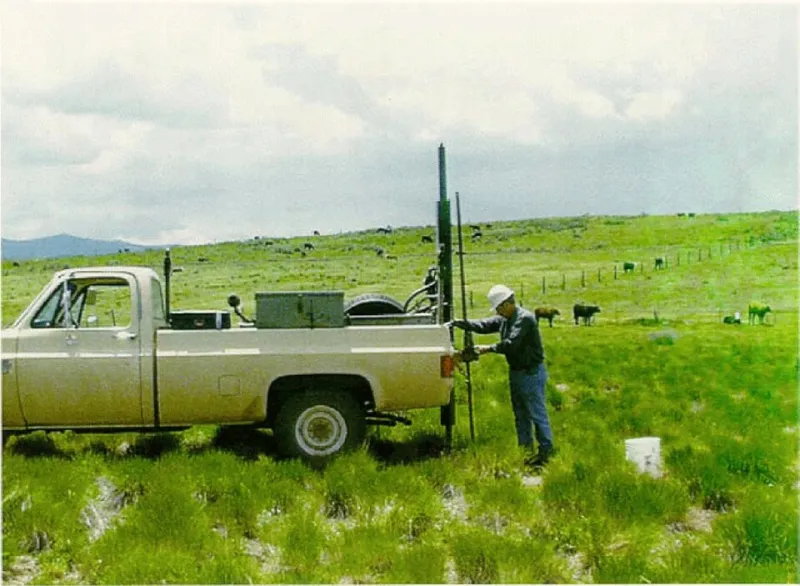
Photo: Unknown, Public domain, via Wikimedia Commons
US tunnel and underground utility programs—transit extensions, water conveyance tunnels, highway crossings, and urban utility corridors—share a familiar pattern. Geotechnical investigation is funded early, compressed when schedules tighten, and then treated as background material once design advances. The bid package follows. Bidders are asked to price excavation, support, dewatering, and lining against a subsurface picture that may be incomplete, inconsistently interpreted, or silent on the very conditions most likely to drive cost. The result is not merely a technical gap. It is a contract risk that gets priced somewhere, by someone, whether or not the owner sees it on the bid tabulation.
A report by any other name
A Geotechnical Baseline Report is sometimes described as a summary of what the borings found. That description undersells its role. In underground construction, the GBR is better understood as a contract exhibit: a stated baseline of expected ground conditions against which changed conditions can be measured. It does not eliminate uncertainty. It defines the uncertainty the owner has chosen to carry and the uncertainty the contractor is expected to price.
That distinction matters in US public works. Federal contracts and many state and local equivalents include differing-site-condition provisions, such as the FAR 52.236-2 clause for federal work, which give contractors relief when actual conditions differ materially from those indicated in the contract. Those clauses are necessary, but they are not a substitute for a clear baseline. A post-award claim may eventually recover cost, but it rarely recovers schedule, disruption, or the credibility of a program. A GBR incorporated by reference, with measurable parameters and a clear relationship to the technical specifications, gives both parties a common reference point before mobilization.
Investigation as bid leverage
Borehole programs are often sequenced as preliminary investigation, design-level investigation, and then—too often—nothing until a contractor requests additional data. That sequence leaves bidders to bridge gaps with assumptions. A more disciplined approach treats investigation as a phased bid instrument. Early borings establish the geologic framework. Design-level borings test alignment alternatives and support excavation-method decisions. Supplemental pre-bid borings, concentrated where alignment, depth, or ground conditions remain uncertain, reduce the number of assumptions a bidder must make.
The cost of additional investigation is easy to see and easy to defer. The cost of insufficient investigation is harder to see because it is distributed across bid contingencies, escalated unit prices, reduced competition, and post-award claims. For US tunnel programs, the question is not whether every borehole can be afforded. It is whether the owner wants to pay for information before award or pay for ambiguity after. Bidders price what they do not know. The less the contract tells them, the more they must protect themselves.
Where the baseline stops
No GBR can resolve every subsurface condition. Fractured rock, mixed-face ground, obstructions, contaminated groundwater, and unmapped utilities can exceed even a well-prepared baseline. The contract should therefore state explicitly how residual risk is allocated. That means clear provisions for differing site conditions, unit-price schedules for variable quantities, and time-related relief where ground conditions affect the critical path. It also means distinguishing between conditions the contractor should reasonably anticipate from the baseline and conditions that fall outside it.
Ambiguity is not neutral. When a contract is silent on who carries a risk, bidders assume the owner will interpret silence in its own favor and price accordingly. In competitive bidding, that assumption may appear as higher contingency, a qualified bid, or a decision not to bid. None of those outcomes improves the owner’s position. Explicit allocation may produce a higher initial bid line, but it produces a more comparable bid and a more defensible award.
Reading the bid for risk
Public procurement rules often constrain how far an owner can go in evaluating risk-adjusted bids. Even so, the bid package can be structured to make ground risk visible. Pre-bid geotechnical data rooms, structured question-and-answer periods, and confidential bidder meetings can reveal where the baseline is unclear without compromising fairness. Bid forms can require breakout pricing for ground support, dewatering, and excavation classes rather than a single lump sum. Those breakouts help owners compare bids and help contractors price what they actually expect.
A low bid that carries an unresolved geotechnical assumption is not necessarily the lowest-cost bid. It may simply be the bid that deferred the cost most effectively. For US tunnel programs entering 2026, the more disciplined approach is to treat the GBR, the borehole program, and the differing-site-condition clause as a single package. The borehole record becomes a contract instrument. The baseline becomes a pricing tool. The clause becomes a dispute-avoidance mechanism rather than a dispute invitation.
Owners do not need perfect ground information to manage underground risk. They need a contract that says what is known, what is assumed, and who carries what remains. That is a program-delivery choice made long before the first tunnel advance—and it is one of the few subsurface decisions that can be priced with confidence.