The Aggregate Blind Spot: Why Material Basins Belong in Early Project Controls
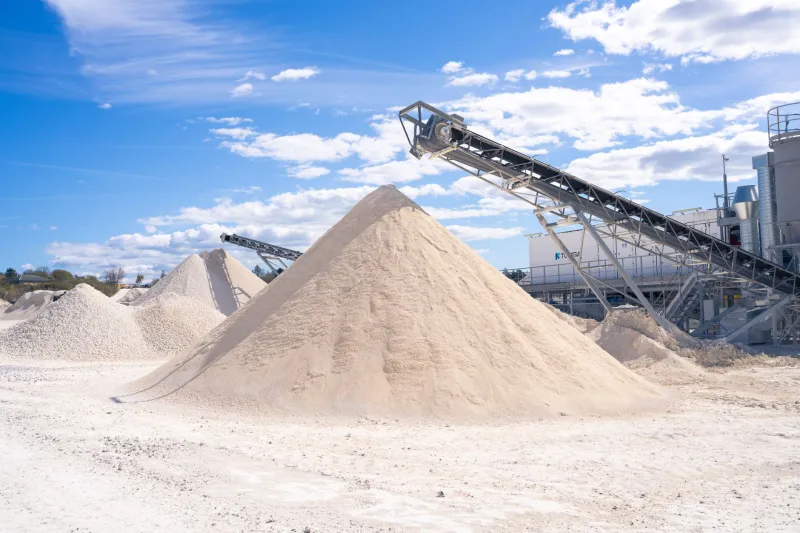
US public-works programs entering 2026 are still absorbing the lesson that schedule risk rarely announces itself at the top of a bid package. It sits lower in the supply chain, in the pit and the rail siding, where crushed stone, sand, and gravel move from a quarry to a stockpile and then to a project that cannot proceed without them. Aggregate is heavy, low-value per ton, and highly local. Those properties make it a quiet governor of schedules, especially when several programs draw on the same basin at once.
The supply basin is a schedule variable
Most project controls models treat aggregate as a line item to be bought when the earthwork contractor mobilizes. That assumption works when sources are abundant, permitted, and close. It fails when a quarry expansion is waiting on a local land-use decision, when a rail spur is shared with other freight, or when a single plant serves three counties and a competing megaproject. The result is a schedule that looks healthy on paper until the first haul truck is turned away.
A more disciplined approach begins with a supply-basin map. For each major material family—base course, structural fill, coarse aggregate, manufactured sand—the project team should identify active sources, permitted reserves, practical haul distances, and the transport modes that can serve the site. The map should distinguish between sources that are contractually available today and those that could become available after permitting, plant upgrades, or rail improvements. That distinction matters because a source that is two years from approval is not a schedule hedge; it is a future option.
Permitting and rail are the hidden gates
Quarry permitting is not a single event. It can involve zoning, air and water permits, traffic agreements, and local opposition that surfaces late. Even a well-run operation may face seasonal restrictions or production limits that reduce output precisely when a program needs volume. Rail adds another layer. Aggregate moves efficiently by rail when the siding, car supply, and yard capacity align. When they do not, trucks absorb the difference, and truck capacity is neither infinite nor cheap.
Owners should ask bidders to describe not only their proposed sources but also the fallback logic behind them. Which alternate source has been qualified? What is the haul time from each? Has the contractor tested material against the specified gradation and durability requirements? A source that meets the specification on paper may fail on consistency, especially for high-friction surface courses or bridge-deck concrete. Early qualification is cheaper than a mid-project substitution.
Qualify alternates before mobilization
Alternate-source qualification should begin during design, not after award. Material testing takes time, and so does the paperwork that allows a source to be added to an approved list. A practical program can set a rule: no major aggregate-dependent work package proceeds to procurement without at least one qualified primary source and one qualified alternate, both with documented haul routes and production capacity. That rule does not guarantee supply, but it forces the question into the open while there is still time to act.
For programs with multiple projects in the same region, the owner can go further and coordinate demand. If three bridge replacements and a highway widening will all require large volumes of base course in the same construction season, the program office should understand whether the basin can support that peak. Sequencing work to smooth demand may be less expensive than paying premiums for scarce material or accepting schedule slippage.
Write resilience into design and procurement
Design choices influence aggregate demand long before construction. Pavement sections, embankment slopes, drainage layers, and concrete mixes all set the volume and quality of material required. Designers can reduce exposure by allowing performance-based alternatives where appropriate, by avoiding unnecessarily tight gradations that only a few plants can meet, and by documenting the material assumptions behind the design. Value engineering should include a supply review, not just a cost review.
Procurement can reinforce the same discipline. Bid documents can require a material-resilience plan that names sources, describes transport modes, identifies alternates, and explains how the contractor will respond to a source interruption. Evaluation criteria can reward plans that demonstrate real basin knowledge rather than generic assurances. Contracts can also include clear notice provisions for material shortages, so that early warnings trigger a coordinated response instead of a dispute.
A practical starting point
For owners launching programs in 2026, the first step is not a new software platform. It is a structured conversation among design, procurement, and construction teams about where material will come from and what could interrupt it. That conversation should produce a basin map, a list of qualified sources and alternates, a rail and truck logistics assessment, and a set of contract clauses that make material resilience a shared obligation.
Aggregate will never be the most visible part of a megaproject. But when the quarry is on the critical path, visibility is not the issue. Schedule is. Treating supply basins as an early project-controls variable gives owners a better chance of keeping earthwork, paving, and concrete work moving when the first source falters.