The Yard Before the Steel: Logistics Master Planning for US Megaprojects
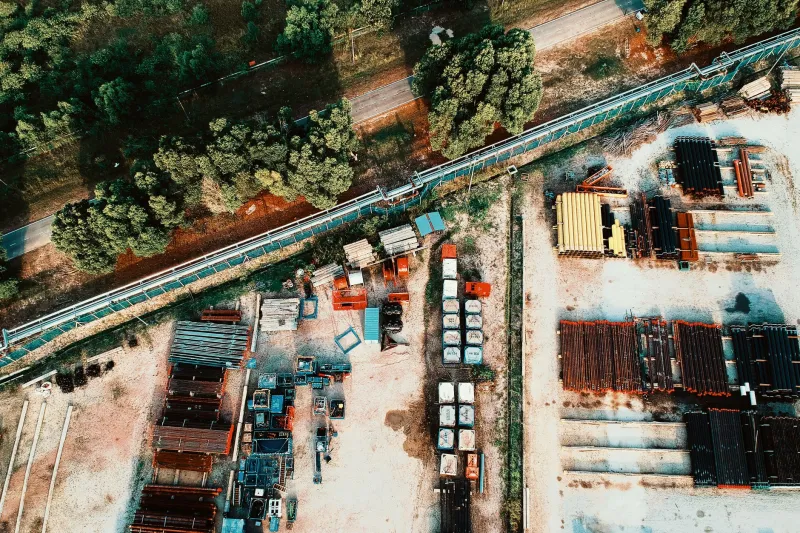
Ask a program director where the schedule is most fragile and the answer rarely involves concrete. It usually involves a gate, a haul route, or an acre of gravel that nobody secured in time. On megaprojects, the laydown yard sits at the intersection of procurement, permitting, and production — and yet it is frequently treated as a housekeeping matter to be resolved once the site is mobilized.
That sequencing is backwards. In congested urban and industrial corridors, the staging area determines what can be delivered, in what sequence, and at what rate. It is a schedule asset before it is a storage asset.
Logistics Is a Schedule Variable
Consider a typical large package: structural steel from three fabricators, precast panels from a regional plant, mechanical equipment with staggered release dates, and a curtain wall system shipped from overseas. Each arrives on its own clock. If the site can receive, hold, and sequence those deliveries, the installation crews work steadily. If it cannot, the project experiences the familiar pattern of idled trades, double handling, and off-site storage billed back through change orders.
Off-site storage is not a solution; it is a cost transfer with a lead time attached. Public storage yards fill up. Trucking from a remote yard adds vehicle cycles to already constrained routes. Each layer of handling introduces damage risk and inventory loss that rarely appears in the baseline schedule but reliably appears in the final account.
Siting: Four Filters Before the First Sketch
Yard selection should be driven by constraints, not availability.
Access geometry. Turning radii, gate width, and approach grades determine whether a 130-foot steel hauler can enter without a police escort. A site that works for a pickup truck may be unusable for the loads that matter.
Throughput, not area. A common error is measuring the yard in acres when the operative metric is dwell time multiplied by vehicle cycles. A smaller yard with disciplined release scheduling will outperform a large yard managed by improvisation.
Entitlement and environmental exposure. Sites near waterways, wetlands, or previously industrial land carry permitting risk that can run longer than the yard's useful life. Early screening for floodplain status, contamination history, and stormwater obligations is cheaper than remediation under schedule pressure.
Distance and route resilience. A yard fifteen minutes away on a route with a single bottleneck is effectively farther than one forty minutes away on a redundant corridor. Model the route, not the radius.
Permitting in Congested Corridors
In dense corridors, the yard often requires its own approvals: local zoning or a conditional use permit, stormwater and erosion control coverage, air quality registration for dust and equipment, and sometimes rail crossing or right-of-way agreements with a state department of transportation. Each runs on its own calendar.
The practical discipline is to treat yard permitting as a parallel workstream with its own critical path, initiated at the same time as the main site's environmental review rather than after it. Program teams that map every approval to an owner, a submission date, and an expected duration consistently find that a single overlooked permit — a driveway approach permit, for instance — sits squarely on the mobilization path.
Where the corridor includes an active rail line, engage the Class I railroad early. Industrial track agreements, clearance reviews, and switch installation are not fast processes, and the railroad's engineering review queue does not accelerate because a project is behind.
Rail and Water as Schedule Insurance
For heavy or high-volume programs, rail access changes the economics and the risk profile simultaneously. A rail-served yard removes hundreds of truck movements from local roads, reduces exposure to driver shortages, and provides a buffer against highway disruption. Inland port and short-line connections can serve the same function for programs located away from the coasts.
The tradeoff is commitment: rail spur construction, maintenance responsibility, and switching charges require a business case that spans the full program, not a single package. That case is strongest when the yard is planned as permanent infrastructure that can be released or repurposed at completion.
Operating the Yard: Visibility Beats Square Footage
A yard without inventory visibility is a field of unidentified crates. Three operating practices make the difference.
First, a single system of record for material status, integrated with the procurement and scheduling platforms, so that planners can see what has arrived, what is in transit, and what is committed to a work front. Second, a gate protocol with scheduled delivery windows, enforced for every vendor regardless of contract size. Third, a defined laydown layout with marked zones tied to work packages, so that installation sequence — not arrival sequence — governs placement.
The measure of success is simple: the number of times a component is handled between receipt and installation. Every additional handling is a cost and a schedule risk that has already been paid for once.
The Test for Any Logistics Plan
Before mobilization, a program team should be able to answer three questions without hesitation. Where does an oversized load enter the site, and what approvals permit that entry? What is the planned dwell time at the yard, and who owns the decision to release material to a work front? What happens to the schedule if the yard is unavailable for two weeks?
If any answer is provisional, the logistics plan is still a sketch. On US megaprojects, the yard is not where material waits. It is where the schedule is either protected or quietly spent.